
The next chapter in my book, “Biology is a Burrito & Other Essays,” is now live! It is highly interactive, so please check out the article on my website: burrito.bio. If you send me feedback that improves the essay, I will credit you in the article and in the printed books. Here is a quick preview:
Microbes are small. Tens of thousands of them fit in the period at the end of this sentence. And yet, despite their tinyness, it is possible to weigh individual microbes with remarkable precision.
A single yeast cell weighs about 100 picograms. An E. coli bacterium weighs 0.55 picograms, or 100 million times less than a grain of sand. With masses so small, weighing a single cell seems an impossible task. After all, a normal kitchen scale resolves down to 0.1 grams, whereas an E. coli weighs 100 billion times less than that. Weighing a cell, then, demands eleven orders of magnitude more precision than the scale in a typical pantry can provide.
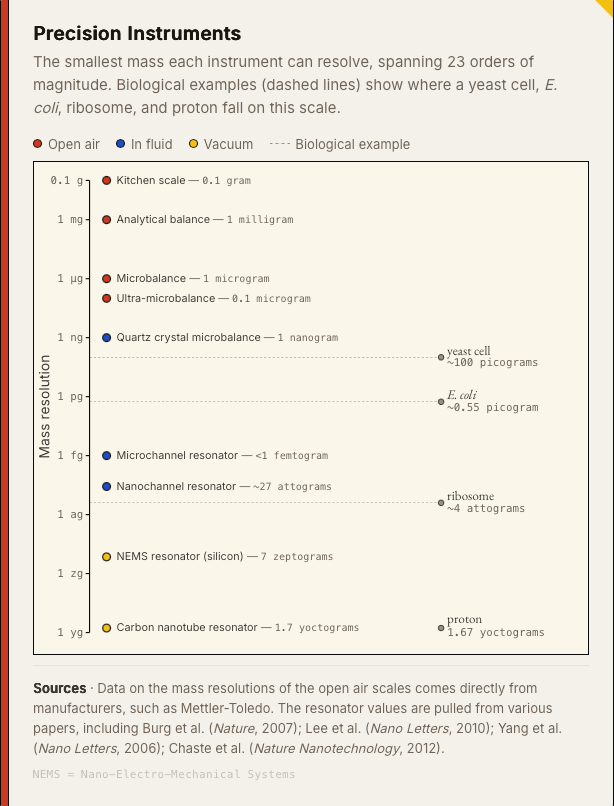
Over the last few decades, scientists have created wondrous devices to weigh individual cells with femtogram precision. Before those devices existed, though, scientists instead made do with whatever was lying around the lab; often just microscopes, centrifuges, and scraps of paper.
Read the rest of this essay — and play with the interactives — at burrito.bio ➔